The Secret Sex Appeal of Muscle

What your hands can feel that your eyes might miss
One of the unexpected things I’ve discovered through my work in somatic sexology is that the hands often notice things the eyes completely miss.
Bodies don’t all speak the same way through touch.
Some bodies feel quiet under the hands. Others feel unmistakably alive, as though the person inside them is fully inhabiting the space they occupy.
Sometimes when my hands rest on someone’s body, the signals arrive almost immediately. A breath deepens. A shoulder softens. A muscle that didn’t realize it was holding tension releases beneath my palms.
In those moments, touch can feel almost conversational: warmth spreading beneath the skin, sensation moving through the body like a quiet current.
Other times, the signals are softer. The body feels quieter, less defined in its responses. The information is still there, but it takes patience to hear.
I should probably mention something here: I touch a lot of bodies.
In my work, touch is often part of the learning process. People explore sensation with their eyes closed, learning to notice subtle differences in texture, temperature, and response.
Once you begin paying attention this way, the body becomes incredibly expressive.
I often joke that I could probably be blindfolded and touch thirty different forearms and still feel how each one is distinct. The density of muscle. The softness of tissue. The warmth of skin. The way a body subtly responds to contact.
Every person’s body has its own texture and language.
There’s something almost magical about that. And honestly, something deeply sexy about it too.
Not in the sense of overt sexuality, but in the sense of vitality—the quiet miracle of feeling another human body responding under your hands.
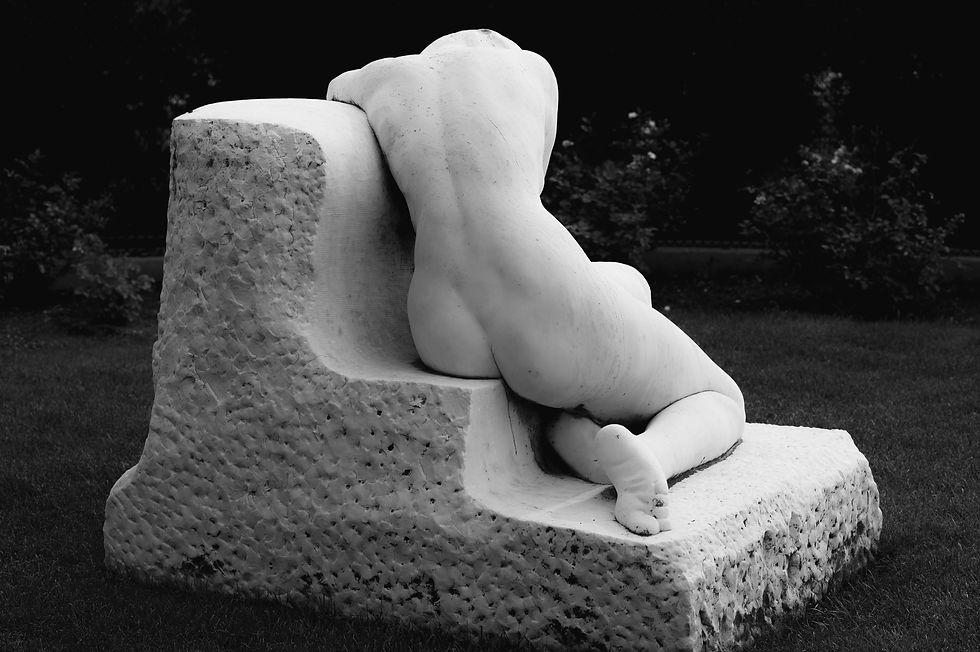
When I’m touching someone’s body for the first time, I sometimes imagine that I’m a blind sculptor.
Years ago, I remember walking through the Louvre and stopping in front of these incredible marble statues that were centuries old, and being completely mesmerized by the level of detail the artists had carved into stone.
The subtle curves of muscle.
The faint striations beneath the surface.
Even the suggestion of softness layered over strength, as though living flesh had somehow been captured in marble.
It’s astonishing what those sculptors could see in stone.
When I close my eyes and touch a body, I sometimes imagine approaching it with that same sense of attention and reverence ...as though my hands are discovering the contours of a living sculpture.
That mindset slows me down. It invites curiosity. It brings a kind of quiet respect to the moment.
And when you begin touching the body with that level of attunement, you start to notice something remarkable.
The body reveals where it is awake.
And often, those places of aliveness are exactly where vitality—and erotic energy—move most freely.
Over time, I began to notice a pattern.
Bodies that regularly engage their muscles (whether that be through movement, strength training, dance, physical work, or simply active living) often feel more responsive to the touch. The tissue carries clearer signals about what the nervous system is doing.
This isn’t really about body size or appearance.
What I’m noticing has much more to do with how fully someone inhabits their body.
Across cultures and traditions, people have described this sense of vitality in different ways.
In yogic traditions it is called prana.
In Chinese medicine it is known as qi or chi.
In Japanese practices, ki.
Ancient Greek philosophers used the word pneuma, referring to breath or the animating spirit of life.
Different languages, same idea: the feeling that life itself is moving through the body.
When someone is deeply embodied, that current tends to flow more freely. Breath expands. Muscles respond and release. Sensation travels more easily through the body.
To the touch, these bodies often feel vibrant ...almost as if there is a quiet hum beneath the skin.
Which brings me to something many people sense intuitively but don’t always talk about out loud:
It's someone's "aliveness" that is attractive.
The most magnetic quality in a human being isn’t perfection.
It’s presence.
It’s the feeling that someone is fully inhabiting their body: that breath, sensation, and vitality are alive and moving through them.
In intimacy, that kind of presence can feel electric.
Interestingly, much of this vitality expresses itself through muscle.
Muscle tissue is where the nervous system communicates most vividly with the body. Muscles tighten when we feel stress, soften when we relax, and pulse with energy during pleasure and arousal.
They are deeply involved in breath, posture, and movement.
In many ways, muscle is where our inner world becomes physically tangible. Under the hands it feels responsive and communicative—engaging, releasing, and subtly shifting beneath the skin. It carries warmth, circulation, and energetic movement.
Fat and connective tissue play important roles in the body, but they tend to transmit sensation more quietly. Muscle, by contrast, is dynamic.
It’s often where the body feels most awake.
Your muscles are where your body feels most alive—and aliveness is one of the most powerful aphrodisiacs there is.
At the same time, vitality doesn’t belong to a single body type.
I’ve touched bodies that are strong and muscular, and bodies that are soft and plush. Bodies that are lean, bodies that are round, bodies that have aged and bodies that are young.
What captures my attention isn’t a particular shape.
It’s the feeling that a body has been inhabited.
A body that has lived a full and vivid life.
A body that has moved, breathed deeply, carried someone through the world.
A body that has stories woven into its muscles and softness alike.
Those are the bodies that feel most compelling to me—not because they meet some aesthetic ideal, but because you can feel the vitality in them.
I’ll admit something here.
I hesitated before writing about this.
Much of my work is rooted in body positivity, and the last thing I want to do is reinforce the idea that bodies need to look a certain way in order to be desirable.
But what I’m noticing through touch isn’t really about appearance.
It’s about vitality.
Bodies that regularly engage their muscles through movement and strength often feel more responsive, more expressive, and more alive under the hands.
And that aliveness can be deeply erotic in ways that have very little to do with aesthetics.
This isn’t about chasing a body ideal.
It’s about cultivating a body that feels alive from the inside.
One of the most reliable ways people reconnect with that sense of vitality is through movement and strength.
Practices like strength training, yoga, dance, martial arts, hiking, swimming, or simply living an active life engage the muscles, breath, and nervous system together.
Over time, these practices strengthen the communication between brain and body.
Muscles become more responsive.
Breath becomes deeper.
Sensation becomes easier to feel and track.
In many ways, physical training is also nervous system training.
People sometimes notice unexpected shifts in their sensual lives when they begin prioritizing movement or strength.
Not because their bodies suddenly look different. But because their bodies begin to feel different from the inside.
One of the quiet misunderstandings about sexuality is the belief that eroticism comes from performance.
Better technique.
Longer stamina.
More impressive choreography.
But from an embodied perspective, the moments people remember most vividly are often much simpler.
A breath that deepens. A body that softens.
The subtle wave of sensation moving through skin and muscle...
In those moments, eroticism has very little to do with performance.
It has everything to do with presence and vitality.
And perhaps that’s why touch can sometimes feel so powerful.
Because when our hands rest on another body, we aren’t just encountering skin.
We’re encountering a life that has been lived.
A body that has carried someone through the world.
And when we slow down enough to listen through our hands—like a sculptor discovering the contours of a living form—we begin to recognize something beautiful.
Sexiness was never about perfection.
It’s about vitality—the feeling of life moving through a body that is fully inhabited.
And when a body truly feels alive,
aliveness itself becomes sexy.


Comments